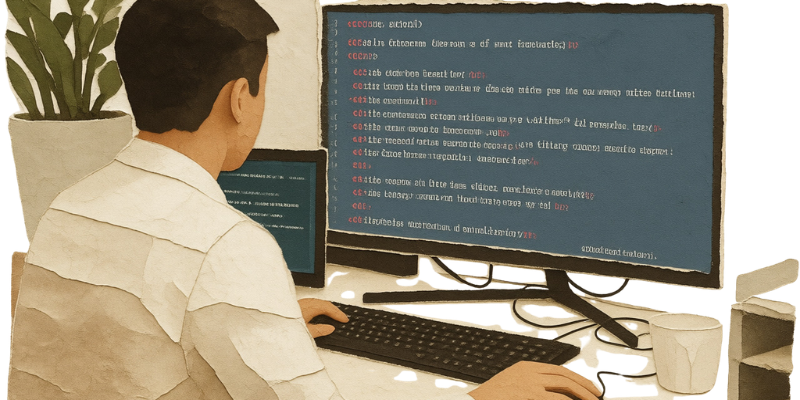
It’s 2:17 AM. Your on-call engineer gets paged. A deployment to production is failing, three services are throwing errors and the pipeline that was supposed to catch this somehow didn’t. By the time someone digs through logs, rolls back the build and writes up an incident report, two hours are gone and nobody got to the root cause.
Sound familiar? Most DevOps teams have a version of this story. The scripts exist. The monitors exist. The runbooks exist. But none of it connects into something that can actually reason about what’s happening and take the right action without waking someone up.
That’s the gap agentic AI DevOps automation is starting to close. Not by replacing your team, but by handling the reactive, repetitive, and time-sensitive work so your engineers can focus on what truly requires human judgment.
What Does ‘Agentic’ Actually Mean?
The word gets thrown around a lot right now, so let’s be clear about what it means in practice.
Traditional automation is scripted. You write a rule, the system follows it. If the rule doesn’t cover the situation, the system either fails or does nothing. It has no awareness of context, no ability to reason across steps, and no way to recover from something it hasn’t seen before.
Copilot-style AI assistance is a step up. It gives your engineers smart suggestions, helps write code faster, and can answer questions about your systems. But it’s still reactive. It waits for a human to ask, then responds. A human still makes the call.
Agentic AI works differently. An agent can receive a goal, break it into steps, take actions across tools and systems, observe the results of those actions, and adjust its approach accordingly. It does this in a loop until the goal is met or it determines it needs human input. In DevOps, that means an agent can monitor a deployment, detect something wrong, check the logs, correlate with recent changes, attempt a fix, verify it worked, and notify the team with a full summary. All without someone being paged.
What is agentic AI in DevOps? Agentic AI in DevOps refers to AI systems that can autonomously plan, execute, and adapt multi-step workflows across your infrastructure, pipelines, and security tooling. Unlike static automation or AI assistants, agentic systems act on goals rather than instructions, making decisions across tools in real time.
Where Agentic AI DevOps Automation Is Showing Up Right Now
This isn’t future-state thinking. Engineering teams are already seeing agentic patterns across four core areas.
CI/CD Pipeline Decision-Making and Self-Healing
Flaky tests, resource exhaustion, race conditions in parallel jobs. These are the mundane pipeline failures that eat hours every week. Agentic workflow CI/CD changes how teams deal with them.
Instead of a failed build just sitting there waiting for a human, an agent can analyze why it failed, determine whether it’s a transient issue or something in the code, decide whether to retry or halt, and if it’s a recurring flake, flag it for the team with the full context already gathered. It can also make gate decisions, choosing whether a build should proceed to the next environment based on test coverage , performance benchmarks, or policy compliance, not just a green/red status.
Teams using agentic workflow CI/CD report fewer interruptions during off-hours and faster mean time to recovery, because the agent handles the first layer of diagnosis before anyone looks at a screen.
Infrastructure Provisioning and Drift Correction
AI infra automation is probably the area where the productivity gains are most visible. Provisioning environments used to mean writing Terraform, waiting for approvals, debugging state conflicts. An agent can take a natural-language request like ‘spin up a staging environment matching prod configuration’ and handle the full workflow: generating the IaC, running it, validating the output, and reporting back.
Drift correction is where things get genuinely useful. When infrastructure drifts from its declared state, an agentic system doesn’t just alert you. It identifies what drifted, checks whether the drift was intentional (by looking at recent change logs and tickets), and either auto-corrects or escalates with a clear recommendation. AI infra automation at this level means your declared infrastructure state actually stays reliable.
Security Policy Enforcement and Threat Response
Security misconfigurations don’t usually announce themselves. They slip through in a PR that looked fine, a dependency that got updated, or a new environment that didn’t inherit all the right policies. AI powered DevSecOps changes where in the lifecycle those issues get caught.
Agentic security agents can run continuous policy checks across your environments, correlate vulnerability findings with deployment history, and take containment actions automatically when a threat is confirmed. Rather than dumping a list of CVEs into a dashboard for someone to triage later, an AI powered DevSecOps agent can prioritize by exploitability, map affected services, and in lower-risk cases, open a remediation PR without human involvement.
This doesn’t mean security becomes a black box. The agent’s decisions and reasoning are logged, auditable, and reviewable. That’s actually one of the requirements for AI Powered DevSecOps to work in regulated environments.
Incident Response and Runbook Execution
Runbooks are only useful if someone runs them correctly under pressure at 2 AM. Agentic systems can execute runbooks autonomously : pulling metrics, checking dependencies, running diagnostic commands, and working through decision trees. When the issue falls outside the runbook, the agent hands off to a human with a complete situation report already assembled.
The result is shorter incident timelines and less cognitive load on the engineers who do get paged.
Traditional Automation vs. Agentic AI DevOps Automation: A Comparison
| Dimension | Traditional DevOps Automation | Agentic AI DevOps Automation |
|---|---|---|
| Decision Making | Rule-based, predefined scripts and conditions | Context-aware, multi-step reasoning with dynamic decisions |
| Human Intervention | Required for most non-standard scenarios | Minimal; agents escalate only when genuinely uncertain |
| Speed of Response | Fast for known scenarios, slow when rules don’t match | Consistently fast across both familiar and novel situations |
| Context Awareness | Limited to what was explicitly programmed | Understands upstream and downstream impact across systems |
| Security Integration | Separate tooling, often post-deployment checks | Embedded at every stage, policies enforced in real time |
| Learning Over Time | Static, requires manual rule updates | Improves from past incidents, feedback, and new patterns |
What This Actually Means for Your Engineering Team
The realistic outcome isn’t that your DevOps engineers disappear. It’s that their work changes in a meaningful way.
When agents handle the reactive layer, like triaging alerts, managing routine deployments, and running standard diagnostics, engineers can spend their time on the work that requires experience and judgment: designing systems that are actually resilient, improving observability, defining the policies that agents enforce, and reviewing the decisions agents make.
The DORA (DevOps Research and Assessment) State of DevOps report has consistently shown that high-performing engineering teams spend significantly less time on unplanned work and rework. Agentic AI DevOps automation pushes more of the unplanned work off human plates entirely.
An Honest Note on Guardrails
Agentic AI still gets things wrong. It can misread context, make confident decisions based on incomplete information, or take an action that’s technically correct but Organizationally wrong. Any team deploying agentic systems needs clear boundaries: what actions agents can take autonomously, what requires approval, and how agents escalate when they’re uncertain.
The teams getting the most value from agentic AI DevOps automation right now are the ones who treat agents as junior engineers on probation: they get real responsibilities, but with guardrails, audit trails and a clear escalation path.
How BuildPiper Fits Into This Picture
If you’re thinking about how to bring agentic AI into your DevOps practice without stitching together a dozen tools and hoping they play nicely, BuildPiper is worth looking at seriously.
BuildPiper is built as an agentic AI DevSecOps platform, which means it doesn’t just provide CI/CD pipelines and security scanning as separate features. The platform is designed around workflows where AI agents can take action across your entire delivery lifecycle: managing deployments, enforcing security policies at the pipeline level, correcting infrastructure drift, and handling incident response flows. The security and delivery layers aren’t bolted together, they’re integrated by design, which is what AI powered DevSecOps actually requires to work in practice.
For teams running microservices or Kubernetes-heavy workloads, BuildPiper’s agentic capabilities mean you get intelligent deployment strategies, real-time policy enforcement, and automated remediation without needing a dedicated platform engineering team to build and maintain all of it. The problems described in this blog, the 2 AM pages, the security misconfigurations that slipped through, the flaky pipelines that nobody has time to fix properly, are exactly the problems BuildPiper is set up to address.
If your team is ready to move beyond reactive firefighting, explore what BuildPiper can do for your delivery pipeline.
Frequently Asked Questions
Q1. What is agentic AI in DevOps?
Agentic AI in DevOps refers to AI systems that can autonomously plan and execute multi-step tasks across your pipelines, infrastructure, and security tooling. Unlike basic automation, these agents reason about context, take actions, observe results, and adjust, all without waiting for a human to intervene at every step.
Q2. How is agentic AI different from DevOps automation we already use?
Traditional automation follows fixed rules and breaks when it hits something unexpected. Agentic AI can handle novel situations by reasoning through them, correlating data across systems, and making judgment calls. It’s the difference between a script that runs and a system that thinks.
Q3. Is agentic AI DevOps automation safe to use in production environments?
Yes, when deployed with proper guardrails. Agentic systems work best when you define clear boundaries: what they can act on autonomously, what requires human approval, and how they escalate uncertain situations. Every action should be logged and auditable, especially in regulated environments.
Q4. Will agentic AI replace DevOps engineers?
No. It shifts what engineers spend their time on. When agents handle reactive work like alert triage, routine deployments, and incident diagnostics, engineers focus on system design, policy definition, and reviewing agent decisions. The role evolves, it doesn’t disappear.
Q5. What makes BuildPiper different from other DevOps platforms?
BuildPiper is built as an agentic AI DevSecOps platform, meaning security and delivery aren’t separate modules bolted together. AI agents operate across the full lifecycle, from pipeline decisions and infra management to real-time policy enforcement and incident response, all from a single integrated platform.
Related Searches
- Automated RCA with Agentic AI: Faster Incident Resolution for DevSecOps
- Cloud-Native Application Development: A Full Lifecycle Approach