What is Kubernetes?
Kubernetes is an open-source container orchestration platform used for running distributed applications and services at scale. Also known as “k8s” or “kube,” Kubernetes automates the deployment, management, and scaling of containerized applications across complex environments.
Today, many organizations use Kubernetes as a powerful kubernetes management platform for enterprises to streamline application deployment, improve resource utilization, and efficiently manage multi-cloud and hybrid cloud infrastructures.
Here’s a quick overview of Kubernetes architecture, its core components, and how they interact with each other. This guide will help you understand the different components of Kubernetes and how they work together to support modern enterprise workloads.
What is a Kubernetes Cluster?
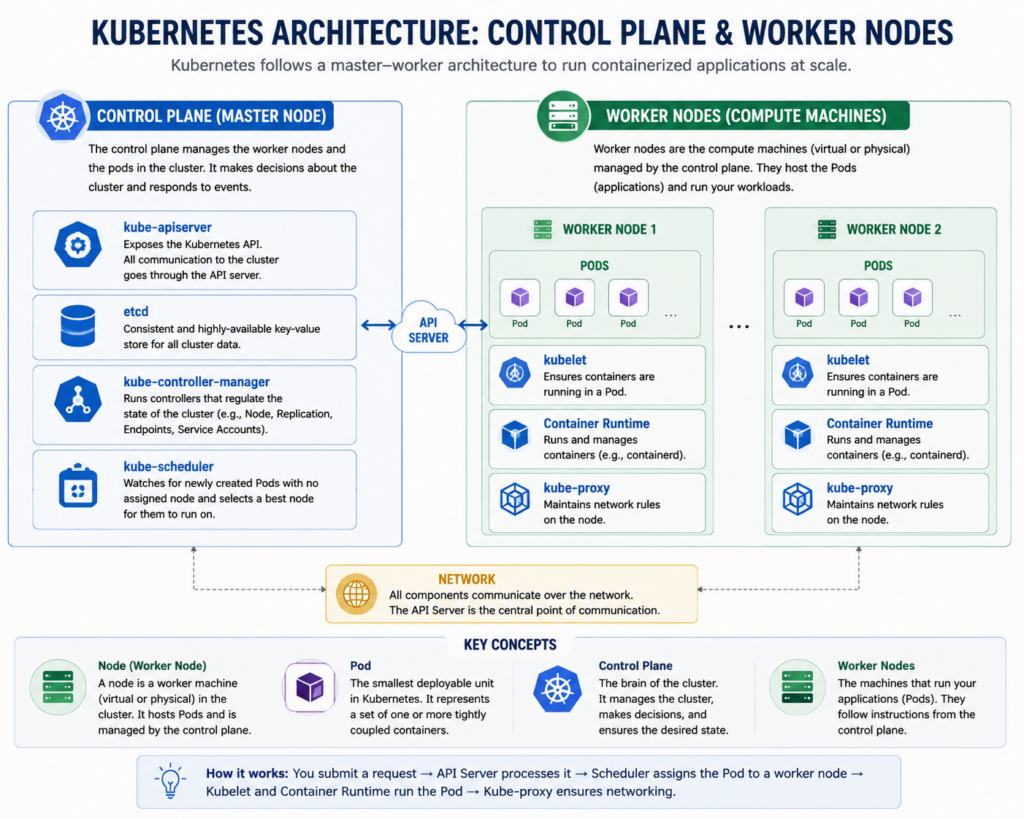
A set of nodes to run containerized workloads and applications is known as a Kubernetes cluster. It has two parts:
- The Control Plane( Master Node)
- The Compute Machines or Nodes( Worker Nodes)
The Compute Machines or Nodes( Worker Nodes)
A node is a worker machine within a Kubernetes cluster. It can either be a virtual or a physical machine depending on the cluster. Each node present inside a cluster is managed by the control plane. A node contains multiple or single pods.
Wondering what are pods in Kubernetes? A pod is the simplest unit in the Kubernetes architecture that represents a set of running containers.
Every cluster has at least one worker node. The worker node(s) are responsible to host the Pods. The automatic scheduling of these pods is controlled and managed by the Kubernetes control plane.
The Control Plane or Master Node
The Kubernetes Control plane manages the worker nodes and the pods within the Kubernetes cluster. The components of the control plane help in taking decisions about the cluster and in identifying and responding to events happening inside the cluster.
Here’s the Kubernetes architecture diagram with all the components tied together.
Kubernetes and its challenges
Managing a production-grade Kubernetes Cluster with complete security, scalability, observability, and reliability is quite a challenging task.
More and more businesses now are adopting Managed Kubernetes to leverage benefits of Kubernetes functionalities while gaining from reduced management overheads and mitigated risks & failures.
How Managed Kubernetes comes to the rescue
BuildPiper, a powerful Microservices & DevSecOps platform is the ideal solution for enterprises to overcome complex Kubernetes deployment challenges. Managed Kubernetes, a unique feature offered by BuildPiper, helps in seamless, secured and scalable cluster management allowing DevOps teams to gain comprehensive observability of the K8s cluster and its components.
Explore BuildPiper
BuildPiper is an end-to-end Kubernetes and Microservices Application Delivery Platform that helps enterprises accelerate their cloud-native transformation journey. With advanced DevSecOps Automation Services, BuildPiper enables organizations to reduce the time, effort, and investment required for Kubernetes and microservices adoption by more than 10X.
Explore BuildPiper and its other core functionalities such as Microservices Management, Security, Compliance & Observability along with Secure CI/CD Pipelines setup for your use cases. Schedule a demo today!
Subscribe here to get the latest on DevOps, Kubernetes deployment, Microservices management, & much more!
Read more on Kubernetes architecture explanation along with a Kubernetes architecture ppt in our next blog. HAPPY READING, till then!