Financial technology has changed how people and businesses access banking, payments, lending, insurance, investment, and other financial services. Behind these digital experiences are increasingly complex software systems that need to process sensitive data, support high transaction volumes, remain available around the clock, and meet strict security and regulatory requirements.
For FinTech companies, releasing software quickly is important, but releasing software securely, reliably, and with appropriate controls is even more important.
This is where DevOps for FinTech becomes increasingly valuable.
DevOps brings development, operations, security, and automation practices together to create a more consistent software delivery lifecycle. For financial services organizations, this approach can help teams automate delivery, improve release reliability, strengthen security controls, increase infrastructure scalability, and build auditability into engineering processes.
When DevOps is combined with security practices, organizations can adopt a DevSecOps approach in which security and compliance are considered throughout the software development and delivery lifecycle rather than only before production release.
What Is DevOps in FinTech?
DevOps in FinTech is the application of DevOps principles, automation, CI/CD, infrastructure management, security, monitoring, and collaboration practices to financial technology environments.
A FinTech DevOps lifecycle can connect:
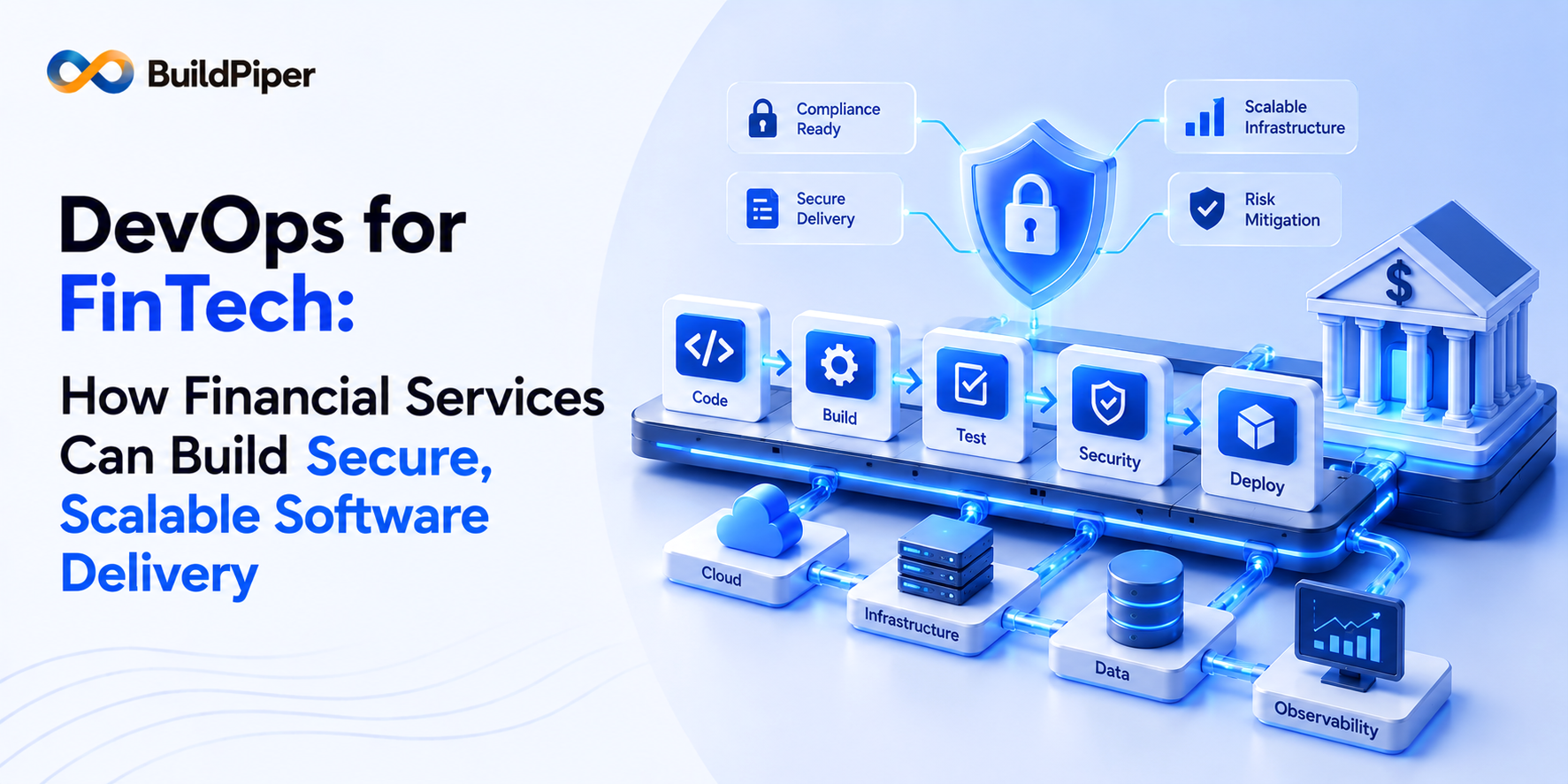
Plan → Code → Build → Test → Secure → Deploy → Monitor → Improve
Instead of relying heavily on manual handoffs between development, operations, security, and infrastructure teams, DevOps helps organizations automate repeatable processes and establish standardized delivery workflows.
For financial services, this can be particularly useful because engineering teams often need to balance several requirements simultaneously:
- Faster software releases
- High availability
- Data security
- Regulatory compliance
- Infrastructure scalability
- Operational resilience
- Continuous monitoring
- Auditability
- Controlled access
- Reliable change management
The goal is not simply to deploy software faster. The goal is to create a repeatable, secure, observable and governed software delivery process.
Why Is DevOps Important for FinTech Companies?
FinTech applications operate in an environment where software failures, security incidents, or uncontrolled changes can have significant operational and financial consequences.
DevOps can help address these challenges through automation, standardization, continuous testing, monitoring, and collaboration.
1. Faster and More Consistent Software Delivery
Financial products increasingly require frequent application updates, new features, integrations, and security patches.
Traditional release processes that depend on manual testing, approvals, configuration, and deployment can slow down delivery and introduce inconsistencies.
CI/CD automation enables teams to create repeatable processes for:
- Code integration
- Automated testing
- Security validation
- Artifact creation
- Deployment
- Release verification
- Rollback
This allows engineering teams to spend less time performing repetitive deployment activities and more time improving financial products and customer experiences.
2. Security Throughout the Software Lifecycle
Financial applications handle highly sensitive information, making security an essential part of the development lifecycle.
A DevSecOps approach integrates security into development and delivery workflows.
Security controls can be incorporated into:
- Source-code workflows
- Dependency management
- Container images
- Infrastructure-as-Code
- CI/CD pipelines
- Kubernetes environments
- Secrets management
- Runtime monitoring
Instead of treating security as a final release checkpoint, teams can identify potential issues earlier in the delivery lifecycle.
3. Compliance and Auditability
Financial services organizations operate within regulatory and organizational control frameworks.
The specific requirements vary by geography, financial product, organization and regulatory environment. However, engineering teams commonly need to demonstrate controlled access, traceability, change management, data protection, and appropriate operational processes.
DevOps can support these requirements through mechanisms such as:
Infrastructure as Code
Infrastructure configurations can be defined and version-controlled, providing greater consistency and traceability.
Automated Policy Checks
Organizations can incorporate policy and security validation into delivery pipelines.
Audit Trails
Deployment events, approvals, configuration changes, and operational activities can be recorded to support investigation and auditing.
Role-Based Access Control
Access to infrastructure, environments, and deployment workflows can be restricted according to organizational responsibilities.
This approach can make compliance a more integrated part of engineering operations.
How to Implement DevOps in FinTech
Implementing DevOps in a financial services environment requires more than adopting a CI/CD tool.
Organizations need to consider architecture, security, compliance, infrastructure, team responsibilities, automation, and operational processes together.
1. Start With Compliance and Governance Requirements
Before automating deployment workflows, identify the controls that apply to the organization and its applications.
Document requirements around:
- Data protection
- Access control
- Change management
- Auditability
- Environment separation
- Security testing
- Secrets management
- Incident response
- Business continuity
- Operational resilience
These requirements can then inform the architecture of the DevOps platform and delivery pipelines.
2. Build a Secure CI/CD Pipeline
A FinTech CI/CD pipeline should include more than build and deployment steps.
A representative workflow could be:
Code Commit → Build → Unit Tests → Security Scanning → Artifact Validation → Integration Tests → Approval/Policy Checks → Deployment → Post-Deployment Validation → Monitoring
Automating these stages helps reduce manual intervention while creating a consistent release process.
Depending on the application and risk profile, organizations can incorporate:
- Static application security testing
- Dependency scanning
- Container security scanning
- Infrastructure security validation
- Automated testing
- Policy enforcement
- Artifact verification
- Deployment approvals
3. Adopt Infrastructure as Code
Infrastructure as Code (IaC) enables teams to define infrastructure through version-controlled configuration instead of relying exclusively on manual provisioning.
Tools such as Terraform can be used to manage infrastructure configurations.
For FinTech organizations, IaC can improve:
- Infrastructure consistency
- Environment replication
- Change tracking
- Deployment automation
- Disaster recovery processes
- Infrastructure governance
IaC also creates a stronger connection between infrastructure changes and the organization’s software delivery lifecycle.
4. Automate Kubernetes and Cloud-Native Deployments
Many financial technology organizations are adopting containers and Kubernetes to run modern applications.
Kubernetes can help organizations manage containerized workloads, but operating Kubernetes at scale introduces its own complexity.
DevOps teams may need to manage:
- Clusters
- Namespaces
- Services
- Ingress
- Configurations
- Secrets
- Resource limits
- Deployment strategies
- Scaling
- Monitoring
- Network policies
A platform layer can simplify these operations by providing standardized workflows for application teams while allowing platform teams to maintain governance over the underlying infrastructure.
5. Implement Secrets Management
Financial applications frequently depend on credentials, API keys, certificates, tokens, and database credentials.
These should not be embedded directly into source code or exposed through deployment configurations.
Organizations can use dedicated secrets-management solutions such as HashiCorp Vault and integrate secret retrieval into application delivery workflows.
A secure approach should include:
- Centralized secret storage
- Controlled access
- Encryption
- Secret rotation
- Access auditing
- Environment-specific configuration
6. Establish Continuous Observability
Fast deployment without visibility can increase operational risk.
FinTech applications require monitoring across application, infrastructure and platform layers.
A modern observability strategy can include:
Metrics + Logs + Traces + Events + Alerts
Teams can monitor:
- Application health
- API performance
- CPU and memory
- Kubernetes resources
- Database performance
- Network behavior
- Deployment health
- Error rates
- Service availability
Technologies such as Prometheus, Grafana, OpenTelemetry, Elasticsearch and other observability platforms can form parts of an enterprise observability stack.
The important consideration is connecting operational signals with the services and deployments that generated them.
Key DevOps Practices for FinTech
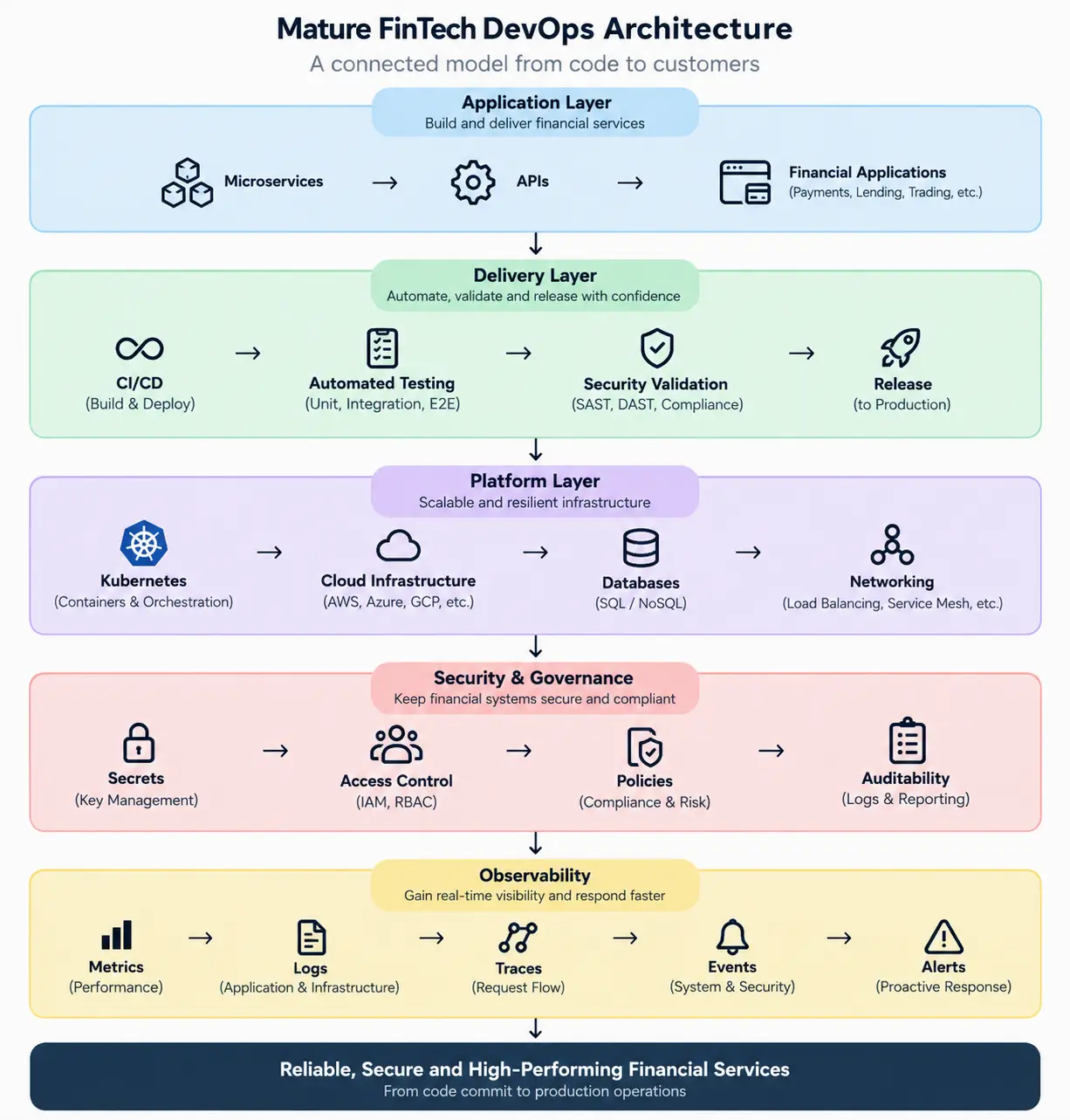
A mature FinTech DevOps strategy typically combines several practices rather than relying on a single technology.
| DevOps Practice | Value for Financial Services |
|---|---|
| CI/CD | Automates repeatable software delivery |
| Infrastructure as Code | Improves infrastructure consistency and traceability |
| DevSecOps | Integrates security into development and delivery |
| Automated Testing | Detects defects earlier in the lifecycle |
| Secrets Management | Protects credentials and sensitive configuration |
| Observability | Provides visibility into application and infrastructure health |
| Kubernetes Automation | Standardizes containerized application operations |
| Policy as Code | Automates governance and policy validation |
| GitOps | Provides version-controlled operational workflows |
| Automated Rollbacks | Helps restore stable application versions after failed releases |
| Role-Based Access Control | Limits access according to organizational responsibilities |
| Audit Logging | Provides traceability for operational and deployment activity |
Common DevOps Challenges in FinTech
Although DevOps can improve software delivery, financial organizations often face additional complexity when implementing it.
Legacy Systems
Many financial institutions operate a combination of legacy applications and modern cloud-native services.
Connecting modern CI/CD and infrastructure practices with legacy environments can require gradual modernization rather than an immediate replacement strategy.
Regulatory Requirements
Automation needs to operate within the organization’s regulatory and internal control requirements.
This can require additional approval workflows, policy enforcement, audit trails, and environment controls.
Toolchain Complexity
Large organizations may already use dozens of tools across development, security, infrastructure, operations and monitoring.
Connecting these tools into a consistent workflow can become a platform-engineering challenge.
Organizational Silos
Development, infrastructure, security, and operations teams may have different processes and responsibilities.
Successful DevOps adoption therefore involves organizational change as well as technology implementation.
Managing Multiple Environments
Financial applications may operate across development, testing, staging, production, disaster recovery, multiple Kubernetes clusters, or multiple cloud environments.
Standardization becomes increasingly important as the environment grows.
How BuildPiper Supports DevOps for FinTech
BuildPiper is an enterprise software delivery and DevSecOps platform designed to help organizations coordinate application delivery, infrastructure, security, observability, and platform engineering workflows.
For FinTech organizations, the platform can provide a centralized approach to managing modern software delivery workflows.
BuildPiper brings together capabilities across areas such as:
- Kubernetes management
- CI/CD pipelines
- Application deployment
- Environment management
- Cloud operations
- Database operations
- GitOps
- Security
- Observability
- DevSecOps
- Engineering workflows
This can help platform and DevOps teams establish standardized delivery processes across applications and environments.
BuildPiper for Secure Application Delivery
A financial application delivery workflow can be represented as:
Developer → Source Control → Build → Test → Security → Artifact → Deployment → Kubernetes → Observability
BuildPiper can act as the orchestration and control layer across these workflows, while integrating with the technologies already present in an organization’s engineering ecosystem.
The objective is not to eliminate every underlying technology.
Instead, BuildPiper provides an abstraction layer that can help teams manage complex delivery processes through standardized workflows.
DevOps Metrics FinTech Teams Should Track
Implementing DevOps should also include measurable outcomes.
Engineering and platform teams can track metrics such as:
Deployment Frequency
How frequently teams successfully deploy software to production.
Lead Time for Changes
How long it takes for a code change to move from development into production.
Change Failure Rate
The proportion of deployments that result in failures requiring remediation, rollback, or other corrective action.
Mean Time to Recovery
How quickly services can be restored following an incident or failed change.
Deployment Success Rate
The percentage of deployment attempts completed successfully.
Pipeline Duration
The time required for the CI/CD workflow to complete.
Security Findings
The number, severity, and remediation time of vulnerabilities identified during development and delivery.
These metrics can help organizations understand whether DevOps transformation is improving delivery performance and operational reliability.
The Future of DevOps in Financial Services
The evolution of FinTech is increasing the importance of automation, platform engineering, cloud-native architectures, security, and intelligent operations.
Emerging engineering environments increasingly combine:
Cloud + Kubernetes + DevSecOps + Platform Engineering + Observability + AI-assisted Engineering
For financial services organizations, the next stage of DevOps is therefore not simply about deploying code faster.
It is about creating secure, governed, observable, automated, and scalable software delivery systems.
Platform engineering can help organizations provide developers with standardized self-service workflows while centralizing governance and operational controls.
AI-assisted DevOps can further support areas such as deployment analysis, troubleshooting, incident investigation, workflow automation, and engineering knowledge access.
Frequently Asked Questions
What is DevOps in FinTech?
DevOps in FinTech applies development, operations, automation, CI/CD, infrastructure, security, and observability practices to financial technology environments. The goal is to improve software delivery while maintaining security, reliability, governance, and operational controls.
Why is DevOps important for financial services?
DevOps can help financial services organizations automate software delivery, improve release consistency, increase operational visibility, support scalability, and integrate security and governance into engineering workflows.
What is DevSecOps in FinTech?
DevSecOps extends DevOps by integrating security practices throughout the software development and delivery lifecycle. In FinTech, this can include security testing, secrets management, access controls, vulnerability scanning, policy enforcement, and auditability.
How does CI/CD help FinTech companies?
CI/CD automates repeatable stages of software delivery such as building, testing, security validation, and deployment. This can help teams release changes consistently while reducing manual deployment effort.
How does Kubernetes support FinTech applications?
Kubernetes provides orchestration capabilities for containerized applications. It can help organizations manage application workloads, scaling, service discovery, and deployment across cloud-native environments.
What role does observability play in FinTech DevOps?
Observability provides visibility into application and infrastructure behavior through metrics, logs, traces, events, and alerts. It helps engineering and operations teams identify performance problems, deployment issues, and service health conditions.
Can DevOps support financial compliance?
DevOps can support compliance-oriented processes through capabilities such as infrastructure version control, audit logging, access controls, automated policy checks, controlled deployments, and traceable change management. Specific compliance requirements depend on the organization, jurisdiction, and financial services it provides.
What is a FinTech DevOps platform?
A FinTech DevOps platform provides tooling and workflows for automating and coordinating software delivery, infrastructure, security, compliance, observability, and operational processes within financial technology environments.
How does BuildPiper help FinTech organizations?
BuildPiper provides an enterprise software delivery and DevSecOps platform with capabilities spanning Kubernetes, CI/CD, application deployment, environments, cloud operations, databases, security, GitOps, and observability. It can provide a unified control plane for coordinating these workflows.
Conclusion
FinTech organizations need to balance speed, security, reliability, scalability, and governance as they continuously develop and operate financial applications.
DevOps provides a framework for connecting development and operations through automation, CI/CD, infrastructure as code, observability, and collaborative engineering practices.
Adding DevSecOps, platform engineering, and governance capabilities can further help financial organizations create standardized and controlled software delivery processes.
For enterprises managing complex applications, Kubernetes environments, multiple delivery pipelines, and distributed engineering teams, a unified platform can reduce toolchain fragmentation and simplify operational workflows.
BuildPiper provides an enterprise software delivery and DevSecOps platform designed to connect application delivery, Kubernetes, infrastructure, security, databases, GitOps, and observability through a unified control plane.
For FinTech and financial services organizations modernizing their software delivery lifecycle, this platform-oriented approach can help create a more standardized path from code to secure production delivery.
Related Searches
- How to Set up CI/CD Pipeline
- Stop Building Script Bridges: Why Your CI/CD Pipeline Should Native-Clone Multiple Repos
- How to Build Multiple Images from One CI/CD Trigger Using Secondary Builds
- Top DevSecOps Consulting Companies in India 2026