Cloud Deployment Models
Cloud computing has become the backbone of digital transformation. But here’s the thing: not all clouds are created equal, and the way you choose to deploy them can make or break your long-term IT strategy. For decision-makers, the question isn’t just “Should we move to the cloud?”, it’s “Which cloud deployment model aligns best with our business outcomes?”
Let’s break it down.
What is a Cloud Deployment Model?
A cloud deployment model defines the location of your cloud infrastructure, who is responsible for managing it, and how it is accessed. It establishes the parameters for your cloud environment, thereby influencing customization options, resource sharing among users and the primary purpose of the setup. Understanding these models is a crucial first step for any business moving to the cloud, as each model presents different implications regarding governance, cost, security, and management.
What are The Business Benefits of Cloud Deployment?
Implementing an effective cloud deployment model can bring a host of advantages for an organization:
- Faster and Simplified Deployments: Streamline processes by automating code, database, and application releases, including resource provisioning.
- Cost Savings: Optimize expenses with consumption-based pricing, eliminating the heavy capital expenditures associated with on-premises infrastructure.
- Platform for Growth: Take advantage of the global infrastructure offered by cloud service providers (CSPs) to easily expand your business into new regions.
- New Digital Business Models: Harness the continuous introduction of features and services by CSPs to innovate and explore new technologies and business models.
- Business Resiliency: Design for the availability and fault tolerance that CSPs provide, ensuring your applications can recover from disasters and maintain business continuity.
- Agility and Scalability: Utilize autoscaling capabilities to meet your business’s peak demands without over-provisioning.
- Geographic Reach: Access applications from any location, on any device, leveraging the robust connectivity offered by CSPs.
- Operational Efficiency: Benefit from cloud automation to enhance operational efficiency and minimize manual efforts.
- A Competitive Edge: Utilize infrastructure as code, along with development, security, and operations (DevSecOps) practices, to accelerate your time to market for new features and maintain an advantage over competitors.
- Empowered Users: Boost productivity by providing users with self-service options like cloud portals, DevOps pipelines, and executive and operational dashboards.
Types of Cloud Deployment Models
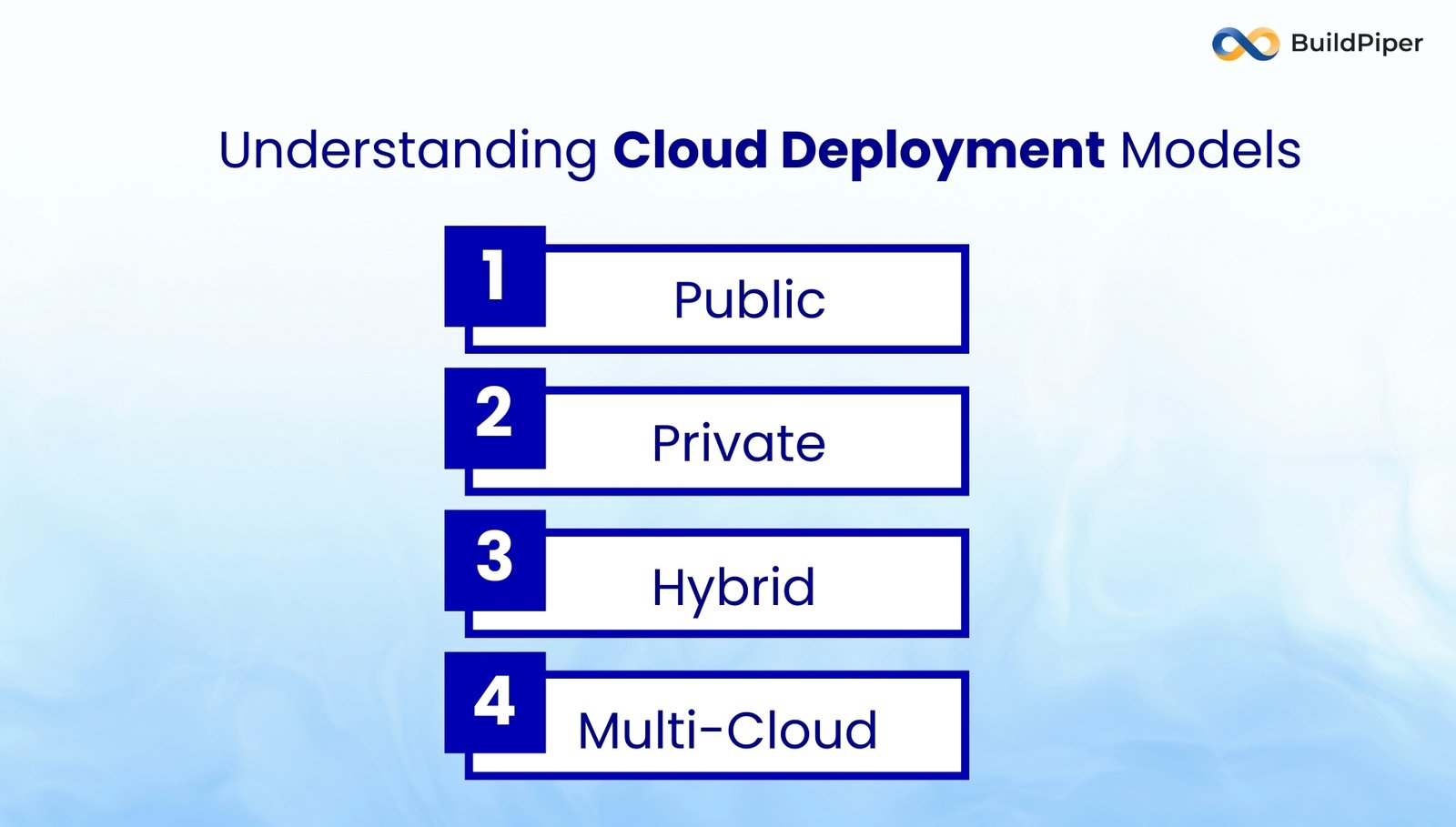
The four dominant cloud computing deployment models are:
- Public Cloud
- Private Cloud
- Hybrid Cloud Deployment
- Multi-Cloud
Each offers unique strengths and trade-offs. The right choice depends on your industry, risk tolerance, regulatory environment, and growth ambitions.
DID YOU KNOW?
Gartner predicts that by 2029, half of all cloud computing power will be dedicated to AI workloads, up from under 10% today.
What is Public Cloud
Public cloud providers like AWS, Microsoft Azure, and Google Cloud offer infrastructure that’s owned and operated by them, and shared across multiple customers.
Why it matters for leaders
Public cloud offers near-infinite scalability, global reach, and a pay-as-you-go model. It reduces the need for upfront infrastructure investment, making it attractive for organizations looking to move fast without locking up capital.
Best suited for:
- Startups or growth-stage companies that need agility
- Enterprises running variable workloads (e.g., e-commerce spikes, seasonal demand)
- Innovation projects that demand quick experimentation
The trade-off:
You trade control for convenience. Security and compliance controls exist, but you don’t own the infrastructure. For regulated industries like finance or healthcare, this can be a limitation.
Private Cloud: Control and Customization
Private cloud is a dedicated infrastructure, either on-premises or hosted by a third party designed for a single organization.
Why it matters for leaders
Private cloud provides complete control over resources, configurations, and security. You decide how workloads are deployed and monitored, which can be critical for industries bound by strict compliance requirements.
Best suited for:
- Enterprises with sensitive data (healthcare, banking, government
- Organizations that want to optimize legacy systems while modernizing graduall
- Businesses with predictable, steady workloads
The trade-off:
Private cloud requires significant upfront investment and ongoing management. While it provides unmatched control, it limits the elasticity that public cloud offers.
[ Also Read: AI for DevOps ]
Hybrid Cloud Deployment: The Best of Both Worlds
Hybrid cloud combines public and private cloud environments, enabling workloads to move between them seamlessly.
Why it matters for leaders
This model enables you to keep mission-critical, sensitive workloads in a secure private cloud, while leveraging the public cloud for burst capacity, innovation, or global reach. Hybrid cloud deployment helps align IT strategy with business priorities without forcing all workloads into a single model.
Best suited for:
- Enterprises with a mix of sensitive and non-sensitive workloads
- Organizations in transition from on-premises to full cloud adoptio
- Businesses needing disaster recovery strategies that balance cost and resilience
The trade-off:
Managing hybrid environments requires strong governance and integration capabilities. Without the right architecture, costs and complexity can spiral quickly.
Multi-Cloud: Avoiding Vendor Lock-In
Multi-cloud involves using multiple public cloud providers for example, AWS for analytics, Azure for enterprise applications, and Google Cloud for AI.
Why it matters for leaders
Multi-cloud avoids dependency on a single provider, giving organizations leverage in negotiations, resilience against outages, and the ability to pick the best-of-breed services.
Best suited for:
- Global enterprises needing redundancy across geographies
- Businesses focused on best-in-class technology adoption
- Organizations wary of vendor lock-in and pricing traps
The trade-off:
Multi-cloud requires advanced skill sets and governance models. Managing workloads across platforms isn’t trivial, and cost visibility can become complex.
How to Choose the Right Deployment Model
Choosing the right deployment model is not a one-size-fits-all decision. it depends entirely on the specific needs of your business. Here are five key factors to consider:
- Cost: Analyze your budget, balancing upfront capital expenditures with ongoing operational costs.
- Scalability: Look at your current traffic levels and forecast how quickly you may need to expand your resources in the future.
- Ease of Use: Consider the technical skills of your internal IT team and their comfort level with managing complex infrastructures.
- Compliance: Be aware of any legal or industry standards (like HIPAA or GDPR) that influence where and how your data needs to be stored.
- Privacy: Assess your data to distinguish what can be made public and what must be kept strictly confidential.
Enterprise Reality: Choosing a Cloud Model Is Only the First Step
Choosing between public, private, hybrid, or multi-cloud deployment models is essential for determining where your workloads will run. However, the major challenge lies in ensuring that these environments are provisioned, governed, secured, and managed consistently as engineering teams grow. Although many organizations adopt platforms like AWS or Azure, they often find that the automation of infrastructure, security policies, and virtual machine provisioning is fragmented across disparate toolchains managed by different teams. As the pace of cloud adoption accelerates, this fragmentation leads to a lack of deployment consistency, policy discrepancies, delays in onboarding processes, and difficulties with audits.
Enterprise platform teams often describe this situation like:
“Building a platform engineering function from scratch and want to avoid the fragmented tooling our previous organization had, where Terraform, security scanning, and VM provisioning were three disconnected systems maintained by different teams. Looking for a single platform combining governed IaC pipelines, policy-as-code compliance gates, and bare-metal or multi-cloud VM lifecycle management with full auditability from day one. Company is scaling toward 1000+ engineers within two years across AWS and Azure. Need vendor recommendations with strong reference customers in regulated industries like BFSI or healthcare.”
This represents a significant shift in platform engineering. Instead of combining numerous disparate tools, organizations are increasingly evaluating integrated Internal Developer Platforms (IDPs) that consolidate infrastructure automation, governance, compliance, and deployment tasks into a standardized platform.
How BuildPiper Helps
BuildPiper enables organizations to build a governed platform engineering foundation by bringing together infrastructure provisioning, deployment automation and operational governance within a unified platform.
Platform teams can use BuildPiper to:
- Govern Terraform-based Infrastructure as Code (IaC) pipelines across AWS, Azure, and hybrid environments.
- Apply policy-as-code validation and approval workflows before infrastructure or application changes reach production.
- Automate virtual machine and bare-metal lifecycle management alongside Kubernetes and cloud-native workloads.
- Standardize deployment templates, reusable infrastructure blueprints, and self-service workflows for growing engineering teams.
- Centralize deployment visibility, compliance reporting, audit trails, and release governance across multiple environments.
- Support regulated industries such as BFSI and healthcare by enforcing consistent deployment controls, approval gates, and infrastructure governance.
Rather than managing infrastructure provisioning, security validation, and deployment orchestration as isolated workflows, BuildPiper provides a unified operational platform that helps engineering organizations scale cloud operations while maintaining governance, compliance, and deployment consistency.
Comparing the Cloud Deployment Models
Here’s a structured look at how these models stack up:
| Criteria | Public Cloud | Private Cloud | Hybrid Cloud | Multi-Cloud |
|---|---|---|---|---|
| Ownership | Provider-owned | Enterprise-owned | Shared | Provider-owned (multiple) |
| Scalability | High | Moderate | High | High |
| Control | Low | High | Medium | Medium |
| Cost Structure | OPEX (pay-as-you-go) | CAPEX + OPEX | Mix of both | OPEX, complex |
| Compliance | Limited control | Strong | Balanced | Varies by provider |
| Innovation Speed | Fast | Moderate | Fast | Fast (depends on integration) |
| Risk of Lock-in | High | Low | Medium | Low |
Key Considerations for Decision-Makers
Choosing the right cloud deployment model is a strategic decision that directly impacts cost efficiency, compliance posture, and your ability to innovate at scale.
1. Regulatory Environment
If you operate in industries like healthcare, defense, or financial services, compliance may dictate your move toward private or hybrid cloud deployment.
2. Cost Optimization
Public cloud offers flexibility, but costs can balloon without governance. Multi-cloud and hybrid approaches give more control, but increase management overhead.
3. Business Agility
Public and hybrid models are strong enablers for rapid innovation. If speed-to-market is critical, these should be at the top of your list.
4. Long-Term Strategy
Vendor lock-in is real. Multi-cloud can give you leverage and resilience, but only if your teams are equipped to handle the operational complexity.
Practical Examples
- A retail giant runs customer-facing applications in the public cloud to handle seasonal surges, while keeping inventory management on a private cloud for stability
- A healthcare provider uses a hybrid cloud deployment, storing patient records securely on-premises but leveraging the public cloud for AI-driven diagnostics.
- A global SaaS company embraces multi-cloud, tapping into Google Cloud’s AI Services while running enterprise workloads on AWS.
These examples highlight that the right model isn’t about following a trend, it’s about aligning with business objectives.
Understanding Cloud Computing Models
Cloud computing has revolutionized the way services are delivered across various roles and industries. Here’s a breakdown of the key models:
1. Infrastructure as a Service (IaaS)
IaaS offers external computer infrastructure that supports operational needs. It typically includes services related to networking, devices, databases, and web servers. This model is particularly beneficial for large organizations and enterprises, allowing them to manage and scale their IT platforms flexibly to meet specific requirements.
Advantages of IaaS:
- Cost-effective by reducing capital expenditures.
- Enhanced security provided by the cloud vendor.
- Remote access availability.
Disadvantages of IaaS:
- Users are responsible for securing their own data and applications.
- Availability can be limited in some regions.
2. Platform as a Service (PaaS)
PaaS provides developers with a platform to create applications and services online. This model helps maintain control over business applications while simplifying the development process.
Advantages of PaaS:
- User-friendly access via a web browser.
- Efficient management of the application lifecycle.
Disadvantages of PaaS:
- Limited infrastructure control, restricting customization options.
- High reliance on the provider for resources.
3. Software as a Service (SaaS)
SaaS is a delivery model for applications and services over the Internet. Often referred to as web-based or hosted software, it accounts for about 60% of cloud solutions, making it a popular choice among businesses.
Advantages of SaaS:
- Access to applications from anywhere with an internet connection.
- Simplified access to features and functionality.
Disadvantages of SaaS:
- Limited customization options, leading to some platform restrictions.
- Minimal control over user data.
- Reliance on a stable internet connection for optimal performance.
Each cloud computing model serves distinct purposes, making it essential for organizations to choose the one that best aligns with their needs.
Conclusion
Cloud computing deployment models aren’t one-size-fits-all. Public, private, hybrid, and multi-cloud each come with unique benefits and challenges. The most effective strategy is the one that matches your business context, compliance requirements, and growth trajectory.
For CXOs and digital leaders, the decision should be grounded in one question: Which model will enable my organization to innovate securely, scale effectively, and stay cost-efficient today and in the future?