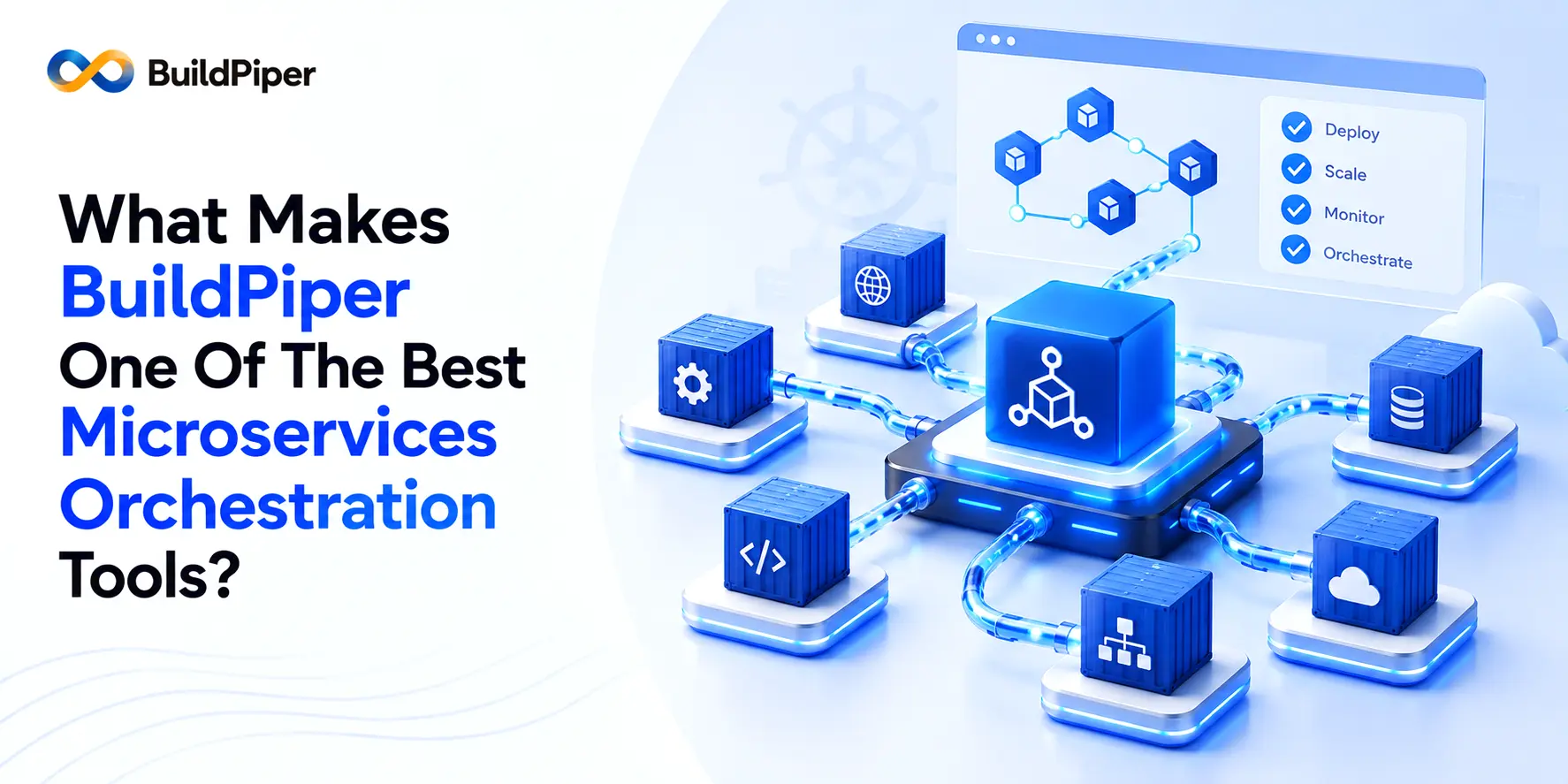
Microservices give engineering teams the flexibility to build, deploy, and scale applications as independently managed services. But as the number of services grows, so does the operational complexity.
Teams may need to manage Kubernetes clusters, containerized workloads, CI/CD pipelines, infrastructure, service configurations, secrets, security controls, observability, deployment strategies, and multiple environments—all while maintaining release velocity and reliability.
This is where microservices orchestration platforms can help.
BuildPiper is an enterprise software delivery and DevSecOps platform designed to simplify the deployment, management, security, and observability of modern microservices environments. It provides a unified control plane for orchestrating applications, infrastructure, databases, and cloud-native workloads across enterprise environments.
Instead of requiring engineering teams to manage every part of the software delivery lifecycle through disconnected tools and manual processes, BuildPiper brings key deployment and operational capabilities into a single platform.
What Is Microservices Orchestration?
Microservices orchestration is the process of coordinating the deployment, configuration, scaling, networking, security, monitoring, and lifecycle management of multiple independent services that together form an application.
A typical enterprise microservices environment can include:
- Kubernetes clusters
- Docker containers
- CI/CD pipelines
- Infrastructure-as-Code
- Service configurations
- Secrets and credentials
- Databases and data services
- API gateways and service meshes
- Logs, metrics, and traces
- Security and compliance controls
- Multiple development, staging, and production environments
Managing these components independently can create operational overhead.
A microservices orchestration platform helps engineering and DevOps teams standardize these workflows while providing greater visibility and control over application delivery.
Why Do Enterprises Need Microservices Orchestration?
Microservices architecture can improve scalability and development flexibility, but operating hundreds or thousands of services introduces new challenges.
Common problems include:
1. Complex deployment workflows
Deploying individual services across multiple environments can require a combination of Kubernetes manifests, Helm charts, CI/CD configurations, scripts, cloud resources, and manual approvals.
2. Toolchain fragmentation
Engineering teams often use separate tools for source control, CI/CD, Kubernetes, infrastructure, secrets, observability, security and incident management.
The tools may work well individually, but connecting them into a consistent delivery workflow can become difficult.
3. Limited deployment visibility
When build, deployment, infrastructure, and application monitoring information exists across different systems, identifying the source of a deployment problem can take longer.
4. Scaling operational processes
As service counts increase, manually maintaining deployment configurations and environment-specific processes becomes increasingly difficult.
5. Security and compliance requirements
Enterprise applications often require controlled access, secrets management, security checks, auditability, and standardized deployment processes.
BuildPiper addresses these challenges by providing a centralized platform for application and infrastructure delivery.
How BuildPiper Simplifies Microservices Orchestration
BuildPiper combines application delivery, Kubernetes management, DevSecOps, observability and infrastructure orchestration capabilities within a unified platform.
Here are some of the capabilities that make it relevant for enterprise microservices environments.
1. Kubernetes-Based Microservices Deployment
Kubernetes has become a foundational technology for running containerized microservices at scale. However, Kubernetes itself does not eliminate the operational complexity associated with deploying and managing applications.
BuildPiper provides an abstraction layer for engineering teams that need to deploy and manage microservices on Kubernetes without building every deployment workflow from scratch.
Teams can standardize application deployment across environments while maintaining the flexibility of Kubernetes underneath.
This can help organizations manage:
- Containerized microservices
- Kubernetes workloads
- Application environments
- Deployment configurations
- Release workflows
- Service-level deployment operations
The result is a more standardized approach to Kubernetes-based application delivery.
2. CI/CD Pipeline Orchestration
A modern microservices environment can require multiple build and deployment workflows.
For example:
Developer → Source Code → Build → Security Checks → Container Image → Deployment → Kubernetes → Observability
BuildPiper helps orchestrate these stages through configurable CI/CD workflows.
Instead of creating separate deployment processes for every service, engineering teams can establish reusable delivery patterns.
This is particularly useful when organizations operate large numbers of microservices and need consistency across development, staging, and production environments.
3. Multi-Service and Multi-Environment Deployment
Enterprise applications rarely run in a single environment.
A typical architecture may include:
- Development
- QA
- Staging
- Production
- Disaster recovery
- Multiple Kubernetes clusters
- Multiple cloud environments
BuildPiper helps teams manage deployment workflows across these environments from a centralized control plane.
This enables platform and DevOps teams to establish standardized deployment processes while giving application teams a more streamlined path from code to production.
4. Centralized Build and Deployment Visibility
One of the challenges with distributed microservices is determining what happened during a deployment.
BuildPiper provides visibility into build and deployment activities through its platform interface.
Teams can use deployment information, logs, events, and status information to investigate problems and understand the state of application releases.
This can reduce the need to move between multiple tools when troubleshooting deployment-related issues.
For engineering organizations, better deployment visibility can contribute to faster incident investigation and lower mean time to resolution (MTTR).
5. Microservices Observability
Deploying a microservice is only one part of operating it successfully.
Teams also need to understand:
- Application health
- CPU and memory utilization
- Kubernetes resource usage
- Node health
- Service availability
- Logs
- Deployment status
- Runtime behavior
- Infrastructure performance
BuildPiper incorporates observability capabilities into the software delivery workflow, helping teams connect deployment activities with operational visibility.
Organizations can integrate commonly used observability technologies such as Prometheus, Grafana, Alertmanager, Elasticsearch, Fluentd, and Kibana depending on their environment and architecture.
This creates a more connected workflow between deploy → observe → troubleshoot → improve.
6. Secrets and Configuration Management
Microservices frequently require credentials, API keys, certificates, tokens, and other sensitive configuration data.
Managing these values directly inside deployment configurations can create security risks.
BuildPiper supports integrations with enterprise technologies such as HashiCorp Vault and service-mesh technologies such as Istio, helping organizations incorporate secure configuration and secrets-management practices into their application delivery workflows.
The objective is to keep sensitive information controlled while allowing services to receive the configuration they need during deployment and runtime.
7. DevSecOps for Microservices
Security cannot be treated as a separate step after application deployment.
Modern enterprise delivery pipelines increasingly incorporate security into the software delivery lifecycle.
A DevSecOps approach can integrate:
Code → Build → Security → Artifact → Deploy → Observe
BuildPiper brings DevSecOps capabilities into the delivery process so engineering teams can incorporate security and compliance requirements alongside application deployment and infrastructure operations.
This is particularly relevant for organizations operating regulated or security-sensitive workloads.
8. A Unified Control Plane for Engineering Teams
One of the biggest operational challenges in modern software engineering is tool fragmentation.
A typical platform engineering team may work with:
- Git repositories
- CI/CD systems
- Kubernetes
- Terraform
- Cloud platforms
- Container registries
- Secrets-management systems
- Monitoring platforms
- Logging platforms
- Security tools
- Databases
BuildPiper’s approach is to provide a unified control plane across application, infrastructure, database, security, and observability workflows.
This helps platform teams create standardized paths for developers without requiring every developer to become an expert in every underlying infrastructure technology.
BuildPiper Microservices Delivery Capabilities
BuildPiper extends beyond basic deployment orchestration through capabilities designed for different parts of the enterprise software delivery lifecycle.
Together, these capabilities position BuildPiper as more than a standalone deployment tool.
It provides an environment where application delivery, infrastructure operations, security, observability, and platform engineering workflows can be coordinated.
BuildPiper vs. Traditional Microservices Orchestration Approaches
Organizations can build their own microservices delivery platform using a collection of open-source and commercial tools.
A common stack might look like:
Git + Jenkins/GitHub Actions + Docker + Kubernetes + Helm + Terraform + Vault + Prometheus + Grafana + Elasticsearch
Each technology solves a specific problem.
The challenge is that engineering teams must also design and maintain the integration layer between those technologies.
A unified platform such as BuildPiper takes a different approach by providing an abstraction and orchestration layer over many of these operational workflows.
| Requirement | Traditional Toolchain Approach | BuildPiper Approach |
|---|---|---|
| Kubernetes management | Multiple Kubernetes tools/configurations | Centralized platform workflow |
| CI/CD | Separate pipeline systems | Integrated delivery workflows |
| Environment management | Scripts and IaC workflows | Environment-oriented platform capabilities |
| Observability | Separate monitoring tools | Integrated deployment + observability workflow |
| Secrets | Dedicated secrets platform | Secrets-management integrations |
| Security | Separate security processes | DevSecOps-oriented workflows |
| Developer experience | Multiple interfaces | Unified control plane |
| Enterprise governance | Custom processes | Standardized platform workflows |
This does not mean that a unified platform replaces every underlying technology.
Instead, it can provide an operational layer that connects these technologies into a standardized developer and platform-engineering experience.
Who Can Benefit From BuildPiper?
BuildPiper is particularly relevant to organizations that have moved beyond simple application deployments and are managing complex cloud-native environments.
Typical users and stakeholders can include:
Platform Engineering Teams
Platform teams can use a centralized control plane to create standardized deployment and infrastructure workflows for application developers.
DevOps Teams
DevOps teams can reduce repetitive deployment operations and establish reusable CI/CD and environment-management processes.
SRE Teams
SRE teams can benefit from better visibility across application deployments, infrastructure, logs, metrics, and operational workflows.
Engineering Leaders
VP Engineering, CTO, and engineering leadership teams can use platform capabilities to improve consistency, governance, developer experience, and software delivery velocity.
Enterprises Running Large Microservices Environments
Organizations operating hundreds or thousands of services can use orchestration and automation capabilities to manage growing deployment complexity.
When Should You Consider a Microservices Orchestration Platform?
A dedicated orchestration platform becomes increasingly relevant when engineering teams experience problems such as:
- Hundreds of microservices
- Multiple Kubernetes clusters
- Frequent production deployments
- Multiple cloud environments
- Increasing CI/CD complexity
- Repetitive deployment tasks
- Long release cycles
- Limited deployment visibility
- High operational overhead
- Growing security and compliance requirements
- Separate tools for development, deployment, security, and observability
- Difficulty providing self-service capabilities to developers
If your engineering organization is facing several of these challenges, a platform-engineering approach can help standardize the software delivery lifecycle.
Conclusion
Microservices architecture can help enterprises build scalable and independently deployable applications, but operating a large microservices environment requires more than Kubernetes or CI/CD alone.
Engineering teams need a connected approach to application deployment, Kubernetes management, CI/CD, environments, infrastructure, databases, security, observability, and governance.
BuildPiper addresses this requirement through an enterprise software delivery and DevSecOps platform that provides a unified control plane for modern application and infrastructure operations.
For organizations looking to standardize microservices delivery, simplify Kubernetes operations, improve deployment visibility, and connect DevOps with security and observability, BuildPiper provides a platform-oriented approach to managing the modern software delivery lifecycle.
Explore BuildPiper to see how an enterprise DevSecOps platform can simplify microservices delivery and platform engineering.
Frequently Asked Questions
What is a microservices orchestration tool?
A microservices orchestration tool coordinates the deployment, configuration, scaling, networking, monitoring, and lifecycle management of multiple microservices. In Kubernetes-based environments, orchestration platforms can provide additional automation and operational abstractions around Kubernetes and application delivery.
Is BuildPiper a microservices orchestration platform?
BuildPiper is an enterprise software delivery and DevSecOps platform that provides capabilities for orchestrating microservices, Kubernetes workloads, infrastructure, databases, security, CI/CD, and observability workflows.
How does BuildPiper help with Kubernetes microservices?
BuildPiper provides Kubernetes-oriented deployment and management capabilities through its KubeOps and related platform workflows. It helps teams standardize application deployment, environment management, observability, and operational processes around Kubernetes-based workloads.
Can BuildPiper manage CI/CD for microservices?
Yes. BuildPiper provides configurable CI/CD and deployment workflows designed to help teams build, release, and deploy microservices consistently across environments.
Does BuildPiper support microservices observability?
BuildPiper provides observability capabilities around application and cluster operations and can work with technologies such as Prometheus, Grafana, Alertmanager, Elasticsearch, Fluentd, and Kibana.
How does BuildPiper support DevSecOps?
BuildPiper incorporates security and governance into software delivery workflows, helping organizations integrate security into application build, deployment, infrastructure, and operational processes.
What is the difference between Kubernetes and a microservices orchestration platform?
Kubernetes is a container orchestration platform that manages containerized workloads. A microservices delivery or orchestration platform can operate at a higher abstraction level, helping teams manage application deployment, CI/CD, environments, security, observability, and developer workflows around Kubernetes and other infrastructure technologies.
Why do enterprises use a unified DevSecOps platform?
Enterprises often operate complex technology stacks with multiple development, infrastructure, security, and observability tools. A unified platform can provide standardized workflows, centralized visibility, governance, and self-service capabilities while reducing operational fragmentation.
Related Searches
- How to Set up CI/CD Pipeline
- What Is Kubernetes Orchestration?
- How to Build Multiple Images from One CI/CD Trigger Using Secondary Builds
- Top DevSecOps Consulting Companies in India 2026