Imagine your engineering team ships a fix. The fix sits in a queue. Three days later, it still has not reached production. Meanwhile, your business has already moved on, your customers have already complained, and your competitors have already iterated. This is not a hypothetical . For fast-scaling ecommerce brands, this is Tuesday.
Lenskart knows this tension well. As one of India’s largest omnichannel eyewear companies , with retail stores, a fast-growing D2C business, and operations spanning multiple geographies, the pressure on its engineering teams was relentless. The business was scaling aggressively. The engineering infrastructure was struggling to keep up. And the gap between how fast product teams wanted to move and how fast deployments could actually happen was getting wider by the quarter.
This BuildPiper Lenskart case study is about what happened when that gap became unsustainable. It is about how a purpose – built microservices onboarding DevSecOps platform changed the way Lenskart’s engineering operations worked , and what that change meant for the business.
What 450+ Microservices Actually Means for a Business
Here is what nobody tells you about microservices: the architecture that gives you flexibility also gives you a coordination problem. Every service needs its own pipeline, its own deployment rules, its own monitoring, and its own rollback strategy. Multiply that by 450, add distributed teams, and you have a situation where your DevOps function becomes a full-time operational fire drill.
According to Spectro Cloud’s State of Production Kubernetes report, 76% of Kubernetes adopters say the complexity of managing clusters at scale has actively inhibited their adoption. For ecommerce companies , that complexity is not just an engineering cost. It delays feature releases, slows hotfix deployments , and increases the risk of downtime during peak traffic periods like sales events or festive seasons, exactly when the business can least afford a platform failure.
At Lenskart’s scale, onboarding a single new microservice meant navigating a web of manual configurations, team handoffs, and inconsistent practices across squads. When that process takes days instead of hours, the compounding effect on velocity is significant. New product capabilities get delayed. Engineering talent spends time on plumbing instead of building. And the risk of a misconfiguration slipping into production grows with every manual step in the process.
What Lenskart Actually Needed
The conversation Lenskart needed to have was not about which Kubernetes tool to pick. It was about what the business needed to achieve: faster time to market for new features, a dramatically lower risk of deployment failures, and an engineering team that could focus on product work rather than infrastructure management.
What that translated to operationally was a platform that could absorb complexity without requiring every team to become a DevOps expert. Standardised deployment pipelines that worked the same way across all services. A way to onboard new microservices without each one being a custom project. And visibility across the entire delivery pipeline so that when something went wrong, the team could respond quickly instead of spending hours tracing the issue.
The ask was clear: reduce the operational overhead of running 450+ microservices on Kubernetes , and make deployment a routine operation rather than a high-stakes event.
Buildpiper Lenskart Case Study
BuildPiper came in as a DevSecOps Platform built specifically for Kubernetes-heavy environments. But the way it made an impact at Lenskart was not through a feature list. It was through operational consistency.
The first shift was in microservice onboarding. What previously took days of back-and-forth between development and DevOps teams was reduced to a guided , standardised workflow. Teams could onboard a new service without needing deep Kubernetes expertise, because the platform handled the configuration, the pipeline setup, and the security policies in a structured way. The result was faster onboarding across the board, with less room for human error.
The second shift was in deployment reliability. BuildPiper introduced standardised CI/CD pipelines across all services, which meant deployments followed the same process regardless of which team was pushing the change. That consistency alone reduced the failure rate and gave leadership visibility they did not have before.
The third shift was speed. With automation handling what used to be manual steps, the time from code commit to production dropped by 80%. For an ecommerce company running multiple releases per week, that is not a marginal improvement. That is a structural change in how fast the business can respond to customer feedback, market shifts, or technical issues.
The security posture also improved, because DevSecOps policies were embedded into the pipeline rather than being an afterthought. Teams did not have to think about compliance checks separately. They happened as part of the standard workflow.
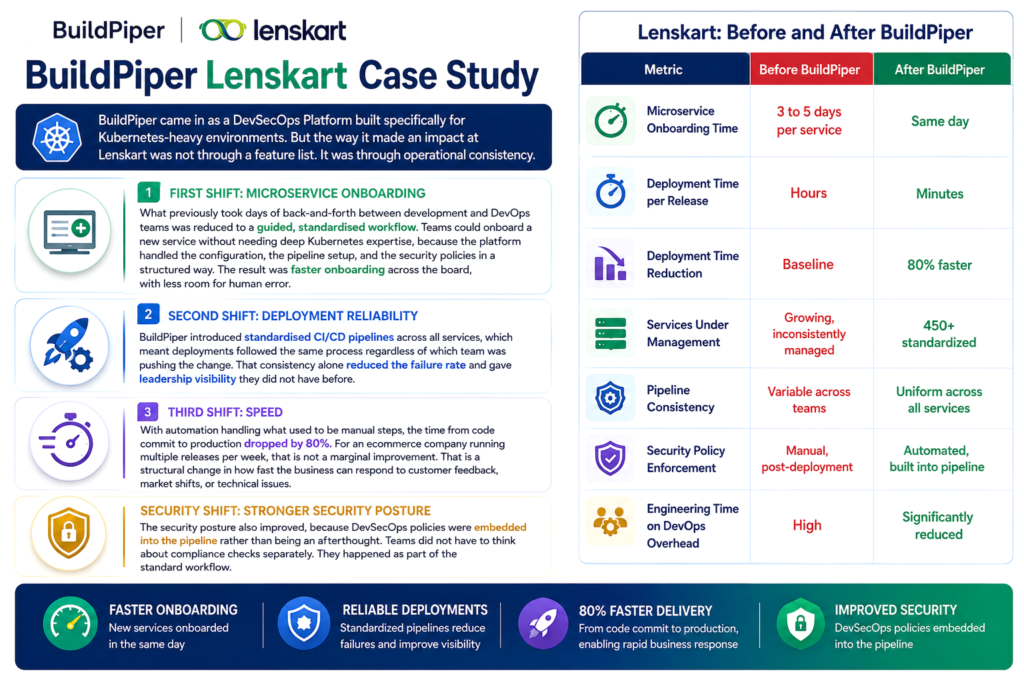
Lenskart: Before and After BuildPiper
| Metric | Before BuildPiper | After BuildPiper |
|---|---|---|
| Microservice Onboarding Time | 3 to 5 days per service | Same day |
| Deployment Time per Release | Hours | Minutes |
| Deployment Time Reduction | Baseline | 80% faster |
| Services Under Management | Growing, inconsistently managed | 450+ standardized |
| Pipeline Consistency | Variable across teams | Uniform across all services |
| Security Policy Enforcement | Manual, post-deployment | Automated, built into pipeline |
| Engineering Time on DevOps Overhead | High | Significantly reduced |
Why This Is a Problem Every Scaling E-commerce Company Will Face
Lenskart’s situation is not unusual. Any ecommerce or D2C company that hits a certain growth threshold , typically when engineering headcount crosses 100 people and services multiply faster than processes can keep up, runs into the same wall.
The companies that manage it well are the ones that recognise it as an organisational problem, not just a technical one. Adding more engineers to a broken deployment process does not fix the process. Bolting on more monitoring tools does not solve the underlying coordination problem. What actually changes the outcome is a platform that makes the right way to deploy also the easy way to deploy, every time, across every service and every team.
The DevOps platform ROI in ecommerce is not measured in infrastructure cost savings alone. It shows up in release frequency, in the ability to ship a personalisation feature before a competitor does, in engineering retention when teams spend their time building instead of firefighting , and in reduced downtime during the moments that matter most to the business.
That is the return that justifies the investment. Not a cost line. A capability shift.
BuildPiper Is Built for This
The Lenskart story is the kind of proof that matters when you are evaluating platforms at enterprise scale. Not a benchmark test. An actual company, with actual complexity, achieving measurable results.
If you are comparing your options, see how microservices onboarding devsecops platform like BuildPiper performs against other platforms at enterprise scale on the BuildPiper vs Devtron comparison page, where you will find customer proof and a detailed breakdown of what differentiates the two platforms in production environments.
If your teams are dealing with the same Kubernetes complexity that Lenskart was, the conversation is worth having. Book a demo with the BuildPiper team and see what the platform looks like in the context of your environment.
FAQs
1: How did BuildPiper help Lenskart reduce deployment time by 80%?
BuildPiperreplaced Lenskart’s manual, inconsistent deployment process with standardised CI/CD pipelines across all 450+ microservices. Automation handled what used to be done by hand, which cut the time from code commit to production from hours down to minutes.
2: How long does it take to onboard a microservice on BuildPiper?
WithBuildPiper, microservice onboarding that previously took three to five days is completed on the same day. The platform provides a guided, standardised workflow that removes the need for custom configuration work on every new service.
3: Do engineering teams need deep Kubernetes expertise to use BuildPiper?
No.BuildPiper abstracts the complexity of Kubernetes management. Teams can deploy and manage services through standardised workflows without needing to be Kubernetes specialists, which frees up engineering capacity for product work.
4: How does BuildPiper handle security across hundreds of microservices?
Security policies are embedded directly into the deployment pipeline, not added after the fact. Every service goes through the same automated compliance checks as part of the standard workflow, which means security coverage is consistent across all services by default.
5: Is BuildPiper suitable for ecommerce companies outside of Lenskart’s scale?
Yes. While theLenskart case reflects a large-scale deployment, BuildPiper is designed to grow with the business. Companies managing 50 microservices today and planning for 500 tomorrow benefit from the same standardisation and automation, just at a smaller starting point.
Related Searches
- Automated RCA with Agentic AI: Faster Incident Resolution for DevSecOps
- Cloud-Native Application Development: A Full Lifecycle Approach